.svg)


Luxury watches are not just timepieces; they are investments, status symbols, and heirlooms. With...

For decades, luxury watchmaking was defined by restraint.
Black dials. Conservative proportions. Quiet craftsmanship appreciated primarily by collectors and insiders.
Today, that world is changing.
In 2026, some of the most talked-about watches are not necessarily the most complicated or traditional. Instead, they are bold, colourful, expressive, and deeply connected to modern culture. The rise of “pop-art horology” is reshaping how collectors interact with luxury watches, blurring the lines between high watchmaking, fashion, art, and hype culture.
Two recent examples perfectly capture this shift: the new Richard Mille RM 07-01 Coloured Ceramics collection, and the newly confirmed collaboration between Swatch and Audemars Piguet.
While very different products, both reflect the same broader movement within the luxury industry.
Luxury Watches Are Becoming More Expressive
Modern collectors increasingly want watches that feel personal, visual, and culturally relevant.
A luxury watch is no longer only about traditional craftsmanship or understated elegance. It is also about identity, visibility, and emotional connection. Younger collectors in particular are entering the market through social media, collaborations, celebrity culture, and design-driven storytelling.
This has opened the door for more experimental aesthetics across the industry.
Bright colours, unconventional materials, playful designs, and artistic collaborations are no longer niche concepts. They are becoming central to how brands attract attention and remain culturally relevant.
Richard Mille and the New Era of High-Colour Haute Horlogerie
Few brands embody this evolution better than Richard Mille.
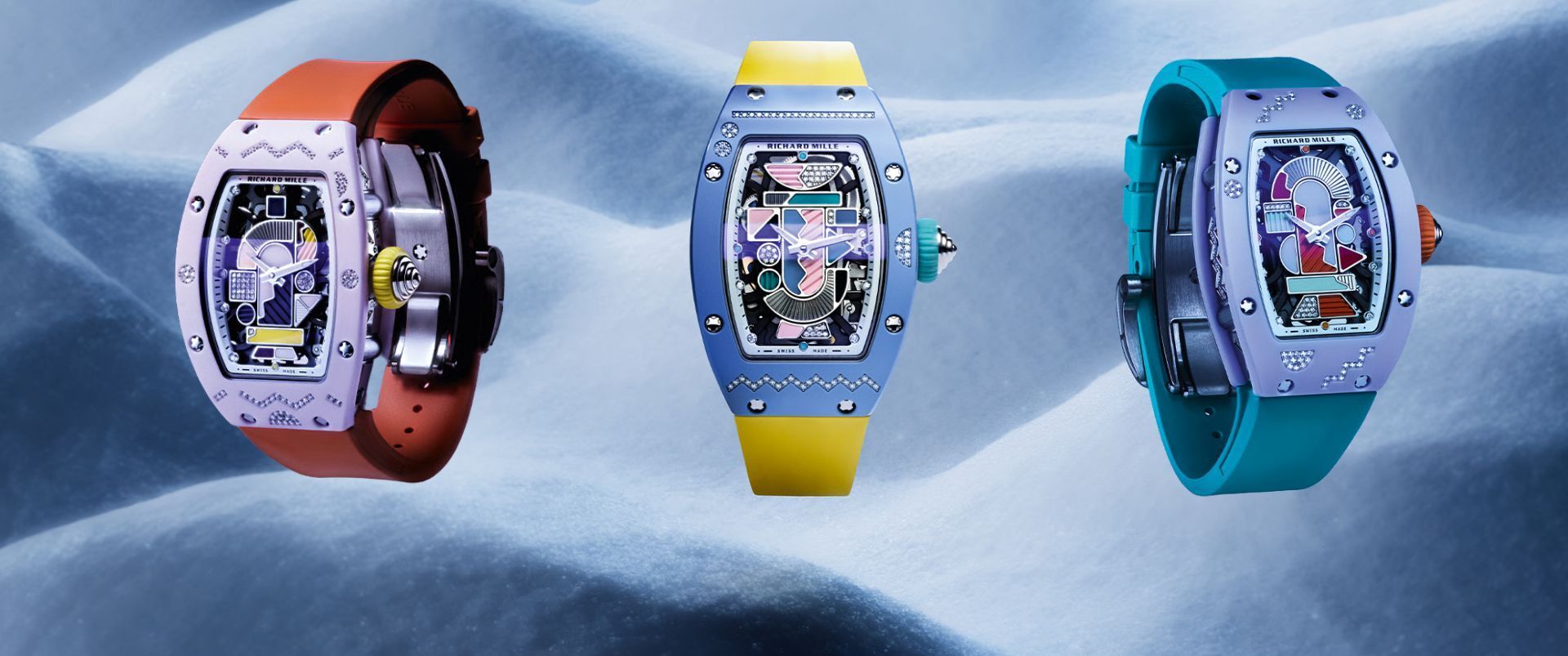
The newly released RM 07-01 Coloured Ceramics collection pushes the brand’s signature formula even further, combining pastel ceramic cases, skeletonised movements, diamond-set details, and highly technical engineering into one bold package.
Available in Lavender Pink, Powder Blue, and Blush Pink, the watches feel almost futuristic in their execution. At first glance, the collection appears playful and artistic. However, beneath the colourful surfaces lies serious mechanical watchmaking.
The watches are powered by the CRMA2 automatic calibre featuring a skeletonised titanium construction, variable-geometry rotor technology, and highly complex finishing techniques typically associated with traditional haute horlogerie.
What makes the collection particularly interesting is its confidence.
Rather than treating colourful aesthetics as secondary to technical credibility, Richard Mille fully embraces both. The result is a watch that feels simultaneously luxurious, expressive, and mechanically sophisticated.
In many ways, it reflects the broader direction of modern luxury itself. Collectors increasingly want products that feel emotionally exciting rather than purely conservative.
The Audemars Piguet x Swatch Collaboration
At the opposite end of the spectrum lies one of the most disruptive collaborations in recent watch history.
On May 9, Swatch officially confirmed its collaboration with Audemars Piguet following teaser campaigns featuring the words “Royal” and “Pop.” Even before the announcement, the campaign had already triggered enormous discussion throughout the watch industry.
The collaboration immediately became a cultural moment.
Swatch previously transformed the market with the MoonSwatch, bringing the design language of the Omega Speedmaster to a dramatically wider audience. The result was unprecedented hype, long queues outside boutiques, and renewed interest in watch collecting among younger consumers.
A collaboration involving the Royal Oak may prove even more significant.
Unlike Omega or Blancpain, Audemars Piguet is not part of the Swatch Group. It is an independent, family-owned manufacturer that has spent decades carefully protecting its exclusivity, production, and brand positioning.
-1.png?width=1120&height=776&name=Email%20Hero%20(18)-1.png)
The Swatch x Blancpain and Swatch x Omega 'Moonswatch'.
That is precisely why this collaboration feels so radical.
The Royal Oak has become one of the most recognisable status symbols in modern luxury culture. Bringing elements of that design language into Swatch’s accessible bioceramic universe fundamentally challenges traditional ideas around exclusivity and accessibility in watchmaking.
At the same time, it demonstrates how powerful cultural relevance has become within luxury. In today’s market, visibility, conversation, and emotional engagement increasingly drive desirability just as much as heritage or price point.
-2.png?width=1120&height=776&name=Email%20Hero%20(17)-2.png)
The Audemars Piguet x Swatch envisioned by Wristcheck.
Collectability Is No Longer Driven by Price Alone
One of the most interesting developments in today’s watch market is that collectability is increasingly influenced by visibility and storytelling, not just price or rarity.
The MoonSwatch proved that accessibility does not necessarily reduce desirability. In many cases, it amplifies it.
Consumers today are deeply connected to products that create conversation, community, and emotional engagement. Social media has accelerated this trend significantly, turning certain watch releases into global cultural events almost overnight.
This is particularly important for younger buyers entering the luxury market.
For many collectors, collaborations and visually distinctive watches serve as an entry point into the broader world of horology. Over time, these consumers often develop a deeper appreciation for craftsmanship, heritage, and mechanical complexity.
In that sense, pop-art inspired watches may actually help expand interest in traditional watchmaking rather than weaken it.
The Future of Luxury Watchmaking
The rise of colourful ceramics, artistic collaborations, and culturally driven releases signals a larger transformation taking place within luxury watchmaking.
Traditional craftsmanship remains essential. However, modern consumers increasingly expect more than technical excellence alone. They want emotion, storytelling, design, and cultural relevance.
Brands that successfully combine these elements are capturing attention far beyond the traditional collector audience.
Whether through the bold experimentation of Richard Mille or the mass-cultural appeal of a Swatch × Audemars Piguet collaboration, one thing is becoming clear:
Luxury watches are no longer simply instruments for telling time.
They are becoming cultural objects designed to be worn, shared, discussed, and experienced.